Macroeconomic Objectives
Economic growth, unemployment, inflation, deflation, government debt, and trade-offs between objectives.
- Explain and measure economic growth; describe its consequences
- Define, measure, and explain the causes and costs of unemployment
- Define, measure, and explain the causes and costs of inflation and deflation
- Calculate the rate of economic growth and the unemployment rate
- Calculate a weighted price index HL
- Explain trade-offs between macroeconomic objectives including the Phillips curve HL
- Explain government debt and its costs HL
This section is pending teacher review.
Economic Growth
Economic growth is an increase in real GDP. Two types:
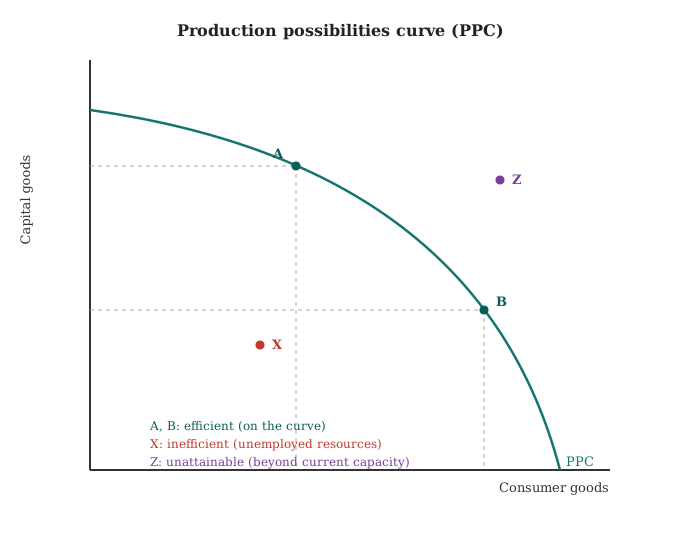
- Short-term (actual) growth — an increase in real output using previously unused resources (movement from inside to the PPC); AD rises
- Long-term growth (growth in production possibilities) — an outward shift of the PPC / rightward shift of LRAS; the economy's productive capacity expands
Consequences of economic growth
- Living standards — generally improve; higher incomes, more goods and services available
- Environment — may worsen (more production = more resource use and pollution), though green growth is possible
- Income distribution — growth does not automatically reduce inequality; gains may accrue to higher earners
Unemployment
The labour force includes all employed and unemployed people actively seeking work.
Difficulties of measurement
- Excludes discouraged workers (stopped looking for work)
- Part-time workers counted as employed even if wanting full-time work (underemployment)
- Informal sector workers not captured
Types of unemployment
| Type | Cause |
|---|---|
| Cyclical (demand-deficient) | Caused by a fall in AD during a recession — insufficient demand for output means fewer workers needed |
| Structural | Mismatch between workers' skills and jobs available — caused by changes in the economy's structure (e.g., decline of manufacturing) |
| Frictional | Workers between jobs; short-term as people search for work |
| Seasonal | Certain industries require fewer workers at particular times of year (e.g., tourism, agriculture) |
The natural rate of unemployment = structural + frictional + seasonal. This is the unemployment that exists even at full employment output.
Costs of unemployment
- Personal: loss of income, reduced self-esteem, skill deterioration, mental health impacts
- Social: higher crime rates, social exclusion, family breakdown
- Economic: lost output, reduced tax revenues, higher government spending on benefits
Inflation
Inflation is a sustained rise in the general price level, measured by the consumer price index (CPI).
Limitations of CPI: basket may not reflect all consumers' spending; quality changes; does not capture housing costs fully; substitution bias.
Causes of inflation
AD rises faster than the economy's ability to increase output. "Too much money chasing too few goods." AD shifts right in AD/AS diagram, raising both price level and output.
Rising production costs (e.g., wages, oil prices) shift SRAS left — higher price level but lower output (stagflation).
Costs of high inflation
- Uncertainty — difficult for firms to plan; reduces investment
- Redistributive effects — debtors gain, creditors lose; fixed incomes eroded
- Reduced saving — real value of savings falls
- Reduced export competitiveness — domestically produced goods become more expensive abroad
- Inefficient resource allocation — price signals distorted
Deflation
Deflation is a sustained fall in the general price level. Not to be confused with disinflation (a fall in the rate of inflation — prices still rising, but more slowly).
Costs of deflation: consumers delay purchases (expecting lower prices later) — "deflationary spiral"; real value of debt increases; bankruptcies; associated with high cyclical unemployment; policy becomes ineffective as nominal interest rates approach zero.
Government (national) debt is the total stock of outstanding borrowing. A budget deficit (spending > revenue in one year) adds to the stock of national debt.
Measured as % of GDP. Costs of high national debt:
- Debt servicing costs (interest payments) crowd out other spending
- Lower credit ratings → higher borrowing costs
- Future generations face higher taxes or lower spending
Trade-offs Between Objectives
| Trade-off | Explanation |
|---|---|
| Low unemployment vs low inflation | Policies to reduce unemployment (e.g., expanding AD) may increase inflation (demand-pull); reducing inflation may require higher unemployment |
| High growth vs environmental sustainability | Rapid growth often increases resource use and pollution |
| High growth vs equity | Growth does not automatically reduce inequality; benefits may be concentrated at top |
The short-run Phillips curve shows an inverse relationship between unemployment and inflation: when unemployment is low, inflation tends to be high (and vice versa).
The long-run Phillips curve (monetarist view) is vertical at the natural rate of unemployment — in the long run, there is no trade-off. Attempts to push unemployment below the natural rate lead only to accelerating inflation, not sustained lower unemployment.
- Economic growth: actual (AD↑) vs productive potential (LRAS↑)
- Unemployment rate = unemployed ÷ labour force × 100
- Types: cyclical, structural, frictional, seasonal
- Natural rate = structural + frictional + seasonal
- Inflation: demand-pull (AD↑) or cost-push (SRAS↓)
- Deflation: falling prices → deferred spending → deflationary spiral
- Short-run Phillips curve: unemployment ↑ ↔ inflation ↓
- Long-run Phillips curve: vertical at natural rate (HL)
Worked examples are pending teacher review.
Worked Example — CPI and Inflation Rate
A consumer spends their income on 3 goods. Year 1 prices and quantities, Year 2 prices:
| Good | Qty purchased | Price Year 1 | Price Year 2 |
|---|---|---|---|
| Food | 50 | $2.00 | $2.20 |
| Transport | 20 | $5.00 | $5.50 |
| Clothing | 10 | $10.00 | $9.50 |
Step 1: Calculate the basket cost in each year
Year 2: (50×$2.20) + (20×$5.50) + (10×$9.50) = $110 + $110 + $95 = $315
Step 2: Set Year 1 as base (CPI = 100); calculate Year 2 CPI
Step 3: Calculate inflation rate
Practice questions are pending teacher review.