Externalities and Common Pool Resources
When markets produce too much or too little, and how to manage shared resources.
- Define externalities and identify all four types
- Distinguish MPC, MSC, MPB, and MSB
- Draw externality diagrams and identify the welfare loss
- Evaluate government responses to externalities
- Explain common pool resources and the tragedy of the commons
- Evaluate policies to manage common pool resources
- Calculate welfare loss from a diagram HL
What is an Externality?
An externality occurs when the production or consumption of a good or service has an effect on third parties who are not part of the market transaction, and when that effect is not taken into account or reflected in market prices.
The four types
| Negative externality | Positive externality | |
|---|---|---|
| Production | Social cost > private cost (e.g. factory pollution) | Social cost < private cost (e.g. honey production benefiting nearby crops) |
| Consumption | Social cost > private cost (e.g. smoking, excessive perfume, loud exhausts) | Social benefit > private benefit — merit goods (e.g. education, vaccination, EVs) |
Key curves
- MPC — Marginal Private Cost (what producers pay)
- MSC — Marginal Social Cost (MPC + external costs). For negative production externalities: MSC > MPC.
- MPB — Marginal Private Benefit (what consumers gain)
- MSB — Marginal Social Benefit (MPB + external benefits). For positive externalities: MSB > MPB.
The socially optimal output is where MSB = MSC. The market produces where MPC = MPB (or MSB, depending on the externality type), which differs from the social optimum, causing a welfare loss.
Negative Externalities of Production
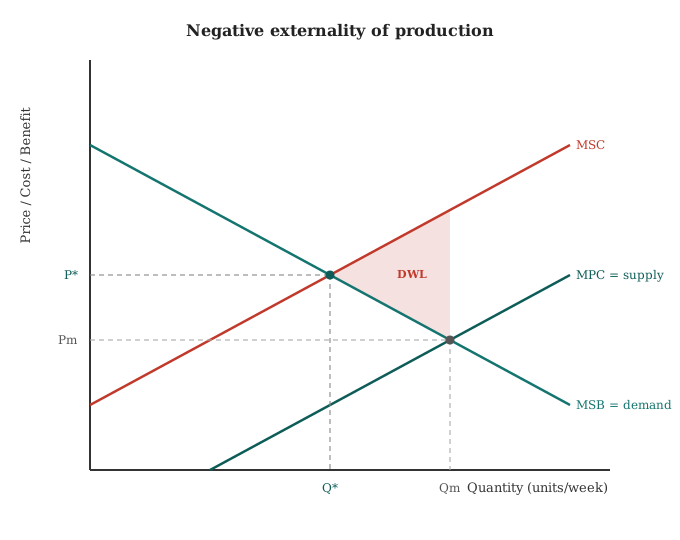
A negative production externality occurs when the production of a good creates external costs borne by third parties not involved in the transaction. These costs are not reflected in the market price.
Result: the market overproduces. The market equilibrium quantity (Qm) is greater than the socially optimal quantity (Qopt). There is a deadweight loss — a triangle of lost welfare between Qopt and Qm.
Government responses
| Policy | How it works | Strengths | Limitations |
|---|---|---|---|
| Pigouvian (indirect) tax | Tax = size of externality per unit → shifts MPC up to MSC, reducing Qm to Qopt | Internalises the externality; raises revenue | Hard to measure the external cost accurately |
| Carbon tax | Tax on carbon emissions → increases cost of polluting production | Price signal encourages cleaner technology | May be politically unpopular; affects competitiveness |
| Tradable permits (cap and trade) | Government caps total emissions; firms trade permits → efficient allocation of pollution rights | Market-based; total pollution is capped | Difficult to set the right price/cap; may create windfall gains |
| Legislation and regulation | Laws directly limit harmful production | Strong, immediate impact | Enforcement costs; risk of black markets; may not be efficient |
| Education | Awareness campaigns to reduce demand for harmful goods | Changes long-term behaviour | Slow; uncertain impact |
Positive Externalities of Production
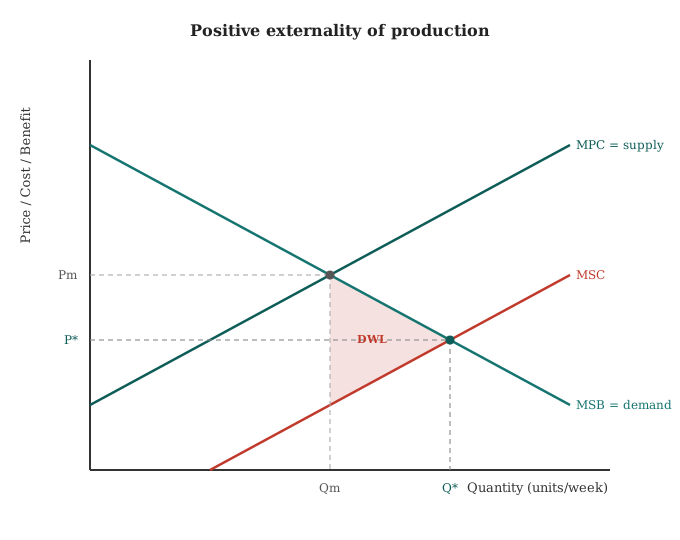
A positive production externality occurs when production creates external benefits for third parties. MSC lies below MPC — the social cost of producing is actually lower than the private cost suggests.
Result: the market underproduces relative to the social optimum. A subsidy can shift supply down from MPC toward MSC, increasing output toward Qopt.
Example: honey production benefits nearby crops through pollination (estimated positive externality of $20/kg).
Negative Externalities of Consumption
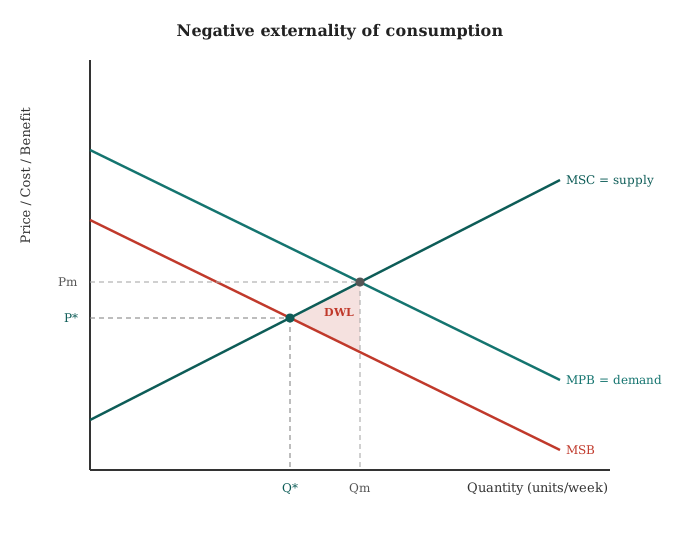
Consumption creates external costs for third parties not in the transaction. MPB overstates the social benefit — MSB < MPB. The market overconsumes. Policies: indirect (Pigouvian) taxes, legislation, education.
Examples: excessive perfume (affecting sensitive individuals), loud exhausts (noise), private car use in cities (air pollution, congestion, road damage), alcohol (drink-driving, healthcare costs, domestic violence).
Positive Externalities of Consumption (Merit Goods)
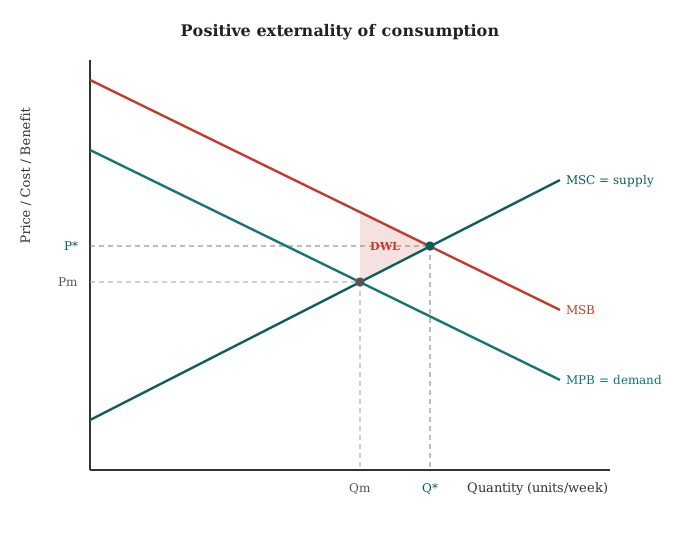
Consumption creates external benefits for third parties. MSB > MPB — the market underconsumes. Policies aim to increase consumption toward the social optimum.
Examples: vaccination, education, public transport use, electric vehicles, smoke detectors, tree planting.
Addressing underconsumption
| Policy | Effect | Advantages | Disadvantages |
|---|---|---|---|
| Subsidies | Supply increases (MSC shifts down); quantity rises and price falls toward Q* | Lower prices encourage consumption; moves toward social efficiency | High fiscal cost; opportunity cost; risk of inefficiency |
| Government provision | Government supplies the good, often free or low-cost | Ensures universal access; strong impact on quantity consumed | Very costly; potential inefficiency; may crowd out private providers |
| Positive advertising | Demand increases, shifting MPB toward MSB | Can change long-term behaviour; avoids distorting prices | Costly; impact depends on consumer responsiveness |
| Legislation (compulsory consumption) | Government requires consumption (e.g. compulsory schooling, vaccines) | Very effective at increasing consumption to MSB | Enforcement costs; perceived loss of personal freedom |
Common Pool Resources
Common pool (common access) resources are rivalrous (one person's use reduces availability for others) but non-excludable (it is not possible to prevent people from using them). Examples: fish stocks, shared grazing land, clean air, groundwater.
The Tragedy of the Commons
Each individual user has a rational incentive to use as much as possible before others do, even though collective overuse destroys the resource for everyone. This is the tragedy of the commons: individually rational behaviour leads to collectively irrational outcomes.
It resembles a prisoner's dilemma — cooperation would be better for everyone, but individual incentives drive overuse. One-off interactions tend toward defection (overuse); repeated interactions allow cooperation to emerge.
Government responses
| Policy | How it works | Strengths | Limitations |
|---|---|---|---|
| Carbon tax | Prices negative externalities of emissions | Creates price incentive to reduce pollution | Hard to set at the right level |
| Cap and trade | Total pollution is capped; firms trade permits | Market-based; total use is controlled | Setting the right price/cap is difficult |
| Subsidies for clean alternatives | Make sustainable options cheaper | Positive incentive; no prohibition | Fiscal cost; opportunity cost |
| Legislation / quotas | Laws directly limit use (e.g. fishing quotas) | Strong and immediate | Enforcement costs; potential black markets |
| Collective self-governance | Local users manage the resource themselves | Local knowledge; stronger compliance; may be more effective than distant government | Can break down; requires trust and coordination |
International cooperation is important for global commons (e.g. oceans, atmosphere). Challenges include monitoring, enforcement, and the difficulty of getting all countries to agree.
Practice questions for this topic will be added here.