Supply
The law of supply, non-price determinants, and shifts of the supply curve.
- Define supply and state the law of supply
- Draw a supply curve and explain movements along it
- Identify non-price determinants of supply and explain how each shifts the curve
- Distinguish competitive supply from joint supply
- Explain the law of diminishing marginal returns and its link to marginal cost HL
What is Supply?
Supply is the various quantities of a good that firms are willing and able to sell at different possible prices during a particular time period, ceteris paribus.
As price increases, quantity supplied increases, ceteris paribus, and vice versa.
Why? As price increases, profit per item rises — there is more incentive to produce. The opportunity cost of not producing also increases. Producers shift resources toward this good and away from related goods.
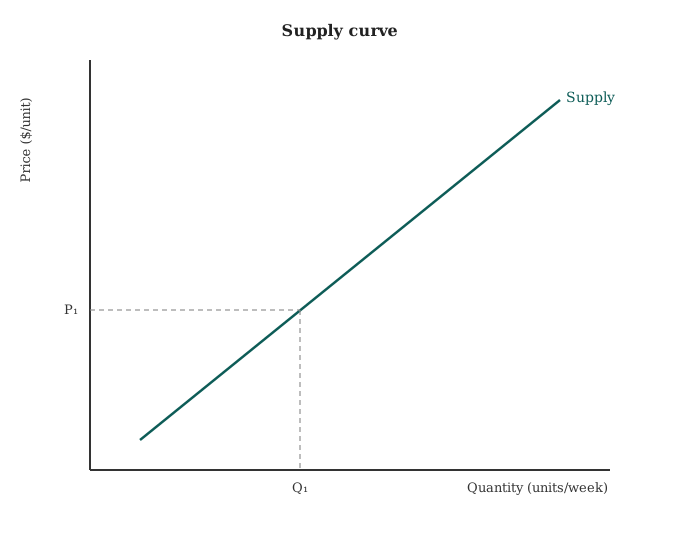
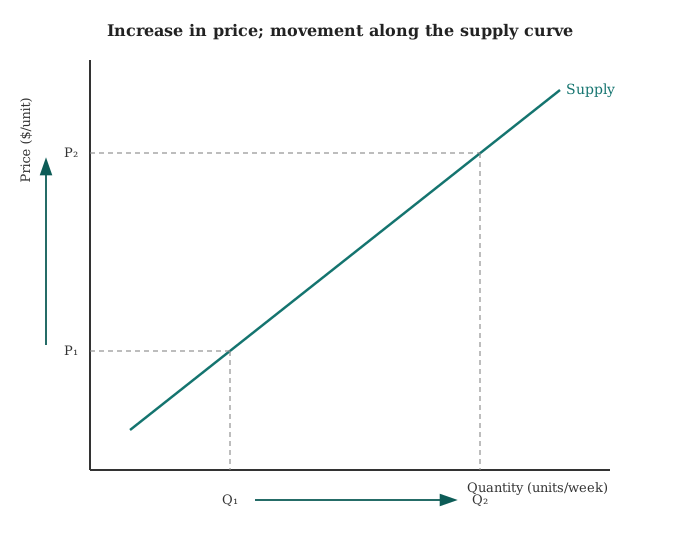
A movement along the supply curve occurs when price changes — this changes quantity supplied.
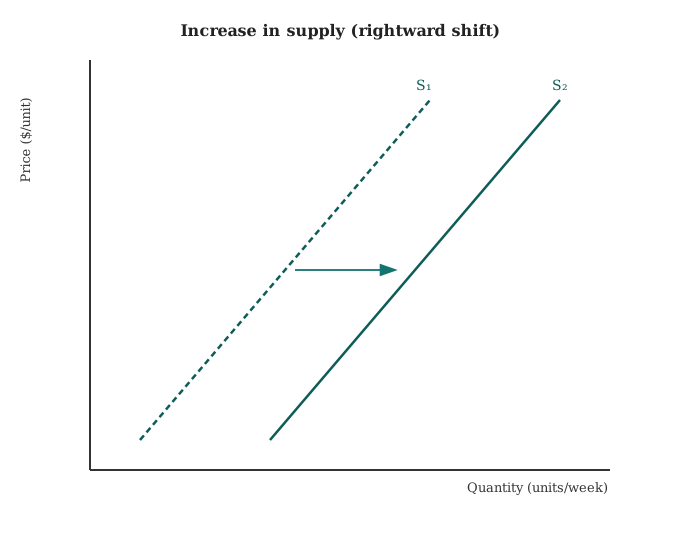
A shift of the supply curve occurs when a non-price factor changes — this changes supply.
Non-price Determinants of Supply
| Factor | How it shifts supply | Example |
|---|---|---|
| Costs of production | Costs up → profitability falls → supply decreases (shifts left) | Oil refinery workers get a pay rise → supply of petrol decreases |
| Technology / labour productivity | Better technology → more output from same inputs → supply increases (shifts right) | New mining equipment makes extraction cheaper → supply of oil increases |
| Indirect taxes | Tax on producers → costs rise → supply decreases | Petrol tax increases → supply of petrol decreases |
| Subsidies | Government payment to producers → costs fall → supply increases | Government subsidises solar panels → supply increases |
| Price of related goods — competitive supply | If a related good's price rises, producers switch resources to it, reducing supply of the original good | Tablet prices rise → producer diverts resources from phones to tablets → supply of phones falls |
| Price of related goods — joint supply | Goods produced together: if supply of one increases, so does the other | More beef produced → more leather hides available → supply of leather increases |
| Price expectations | If producers expect higher future prices, they may withhold supply now | Producers expect petrol prices to rise → supply today decreases |
| Number of firms | More firms → market supply increases | New competitors enter → market supply rises |
| Shocks | Unexpected events (weather, disasters, conflict) reduce supply | A huge storm wrecks several oil tankers → supply of oil falls |
For any non-price change, explain:
- What the change does to profitability per item or the amount that can be produced at a given price, and why
- How that affects willingness and/or ability to sell at any given price
- The resulting direction of the supply shift
Example: An increase in regulation makes it more difficult to produce, increasing costs of production and requiring new investment. This decreases profitability. Producers become less willing and able to produce. Supply decreases.
HL: Why the Supply Curve Slopes Up
Short run vs long run HL
In the short run, at least one factor of production is fixed. In the long run, all factors can change. The supply curve represents the short run.
Diminishing Marginal Returns HL
Marginal product is the additional output produced by one more unit of a variable input, keeping other inputs fixed.
Diminishing marginal returns occur when extra units of a variable input add less and less to total output because they are combined with a fixed input.
Example: a car factory with a fixed floor space. The first robot arm produces a large rise in output. The second adds less. The third adds very little — most tasks are already automated. Each successive arm has lower marginal product.
Link to marginal cost and the supply curve HL
Falling marginal product means each additional input adds less output — so more input is needed to produce each extra unit. More input means higher cost per unit. Falling marginal product leads to rising marginal cost. Rising marginal cost means firms will only supply more if the price also rises — explaining the upward slope of the short-run supply curve.
Practice questions for this topic will be added here.