Competitive Market Equilibrium
How markets clear, the price mechanism, consumer and producer surplus, and allocative efficiency.
- Define equilibrium and explain how markets reach it
- Analyse shifts in demand and supply using a step-by-step method
- Explain the functions of the price mechanism: signalling, incentives, and rationing
- Explain consumer surplus and producer surplus and identify them on a diagram
- Explain allocative efficiency in terms of MB = MC
- Calculate consumer and producer surplus from a diagram HL
Equilibrium
The equilibrium price is the price at which the quantity demanded equals the quantity supplied (Qd = Qs). At this price, the market clears — everyone who wants to buy or sell at that price can do so.
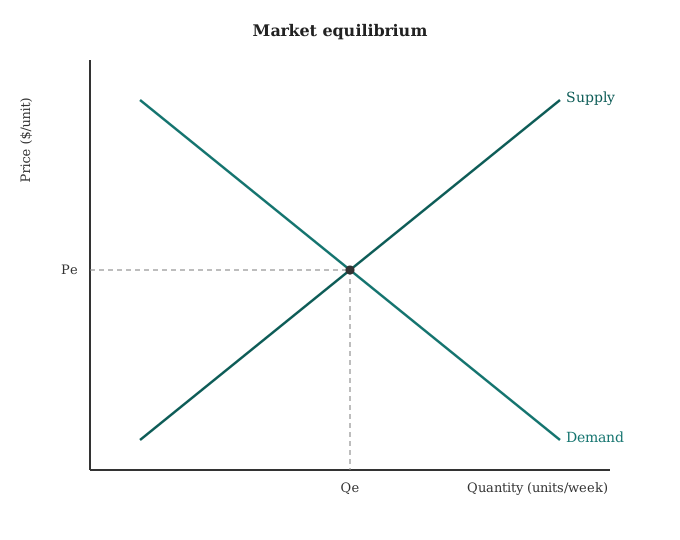
Getting to equilibrium
| Situation | What happens | Result |
|---|---|---|
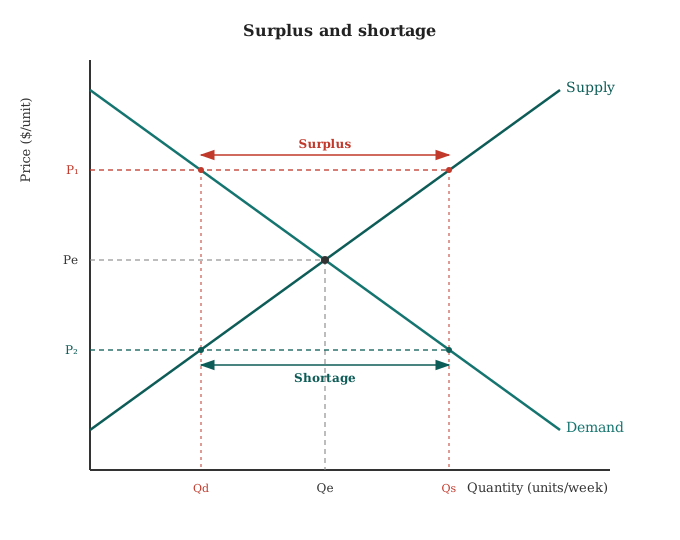
| Price too high → surplus (Qs > Qd) | Producers lower prices to clear their inventory | Price falls, Qd rises, Qs falls, until Qd = Qs |
| Price too low → shortage (Qd > Qs) | Consumers bid up the price | Price rises, Qd falls, Qs rises, until Qd = Qs |
Analysing Changes in Equilibrium
- State the cause: "A change in [factor] has occurred. Ceteris paribus, this affects the [demand/supply] side of the market."
- State the curve shift: "This causes the [demand/supply] curve to shift [right/left] from [D₁ to D₂ / S₁ to S₂]."
- Describe the immediate imbalance: "At the original equilibrium price P₁, [quantity demanded now exceeds quantity supplied → shortage / quantity supplied now exceeds quantity demanded → surplus]."
- Explain the market response: If shortage: "consumers bid up the price — movement along demand curve (Qd falls) and movement along supply curve (Qs rises)." If surplus: "producers lower the price — Qd rises, Qs falls."
- State the new equilibrium: "The market moves from E₁ to E₂. The equilibrium price changes from P₁ to P₂, and equilibrium quantity from Q₁ to Q₂."
- Conclude: "Overall, [factor] shifted [demand/supply], leading to a new equilibrium with [higher/lower] price and [higher/lower] quantity."
Where there are numbers on the graph, include these beside the labels, e.g. P₁ = $5.
Functions of the Price Mechanism
| Function | How it works |
|---|---|
| Signalling | Price changes send signals to producers and consumers about relative scarcity or abundance |
| Incentives | Higher prices incentivise producers to produce more; lower prices incentivise consumers to buy more |
| Rationing (price rationing) | When a good is scarce, a higher price rations it among those willing and able to pay. Non-price rationing uses other mechanisms (queues, permits, etc.). |
These functions are how the price mechanism leads to allocative efficiency: resources flow toward the goods consumers most prefer, without any central direction.
Consumer and Producer Surplus
The big idea
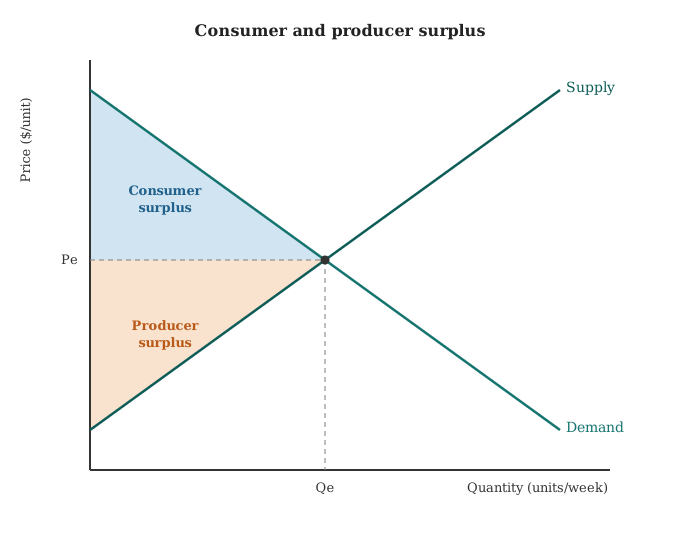
Different consumers value the same good differently. Some would pay far more than the market price; some only just buy it because the price equals what it is worth to them. In the market, everyone pays the same price. Consumer surplus is all the extra benefit that buyers get from paying less than the maximum they would have been willing to pay — the "bonus value."
On a diagram: the area under the demand curve but above the price line.
Different producers are willing to sell at different prices. Some would sell very cheaply; others only sell if the price is higher. In the market, everyone receives the same price. Producer surplus is all the extra benefit producers gain by selling at a price above the minimum they would have accepted — their cost.
On a diagram: the area above the supply curve but below the price line.
Technical definition
- Consumer surplus (CS) = Total Benefit (area under demand curve up to Q) − Amount Spent (P × Q)
- Producer surplus (PS) = Total Revenue (P × Q) − Total Cost (area under supply curve up to Q)
- For a linear demand and supply: CS and PS are triangles → area = ½ × base × height
Allocative efficiency
Social surplus (CS + PS) is maximised at the competitive market equilibrium, where MB = MC (marginal benefit equals marginal cost). This is the condition for allocative efficiency.
If output is above or below the equilibrium, there is a deadweight loss (DWL) — a triangle of social surplus that is lost. DWL represents free utility that has been destroyed by not being at the allocatively efficient output.
Worked Example — Consumer and Producer Surplus HL
At market equilibrium: Price = $5, Quantity = 500 units. The demand curve reaches the price axis at $10 and the supply curve originates from the origin (P = $0 at Q = 0).
Consumer Surplus
Producer Surplus
Social Surplus
This is maximised at the competitive equilibrium. Any deviation creates a DWL.
Practice questions for this topic will be added here.