What is Economics?
The economic problem, scarcity, choice, opportunity cost, factors of production, economic systems, and the PPC.
- Define economics as a social science and distinguish microeconomics from macroeconomics
- Identify and explain the nine key concepts
- Explain the economic problem: scarcity, choice, and opportunity cost
- Describe the four factors of production, including the broader meanings of capital
- State and explain the three basic economic questions
- Distinguish free market, planned, and mixed economic systems
- Draw and label a PPC and use it to illustrate scarcity, choice, opportunity cost, efficiency, and growth
Economics as a Social Science
Economics is a lens on the world — on people, and on people in the world. As a social science, it studies human society and behaviour, the organisation of economic activity, and uses the scientific method to build and test theories.
Looks at one small part of the economy. For example: why are flights within New Zealand often more expensive than similar distances in Southeast Asia? How does a price change by Grab affect the number of motorbike rides taken?
Looks at the economy as a whole. For example: why might Vietnam's government increase infrastructure spending during a slowdown? How does a fall in global oil prices affect inflation in New Zealand?
The Economic Problem
The fundamental economic problem is scarcity and choice. Scarcity arises when available resources (factors of production) are finite whereas wants and needs are infinite. Because there is scarcity, we need to make choices. Choices lead to an opportunity cost — if we choose one thing, we cannot have another. The types of choices we face are captured in the three basic economic questions.
Economics is the study of choices, leading to the best possible use of scarce resources, to best satisfy the unlimited wants and needs of human beings.
The Nine Key Concepts
IB Economics is organised around nine key concepts that apply across all topics.
Factors of Production
Resources used in production are grouped into four factors of production:
| Factor | What it includes | Examples |
|---|---|---|
| Land | All gifts of nature — agricultural and non-agricultural land, and everything under or above it | Minerals, water, fish, forests |
| Labour | The physical and mental efforts of people used to produce goods and services | Plumbers, farmers, teachers, doctors, pilots |
| Capital | Man-made resources used to produce other goods and services (physical capital). "Capital" also has broader meanings — see below. | Machinery, tools, factories, roads, airports, electricity generators |
| Entrepreneurship | The human skill of organising the other three factors, taking on risk, and innovating | Starting a business, combining resources to create a new product |
The word "capital" appears in different contexts. All refer to things that can be used in future production:
- Physical capital — man-made factors of production (the FOP definition above)
- Human capital — the skills, knowledge, and experience of workers
- Natural capital — natural resources available for future use
- Financial capital — money and financial assets
The Three Basic Economic Questions
Because of scarcity, every society must answer three fundamental questions:
- What (and how much) to produce?
- How to produce it?
- For whom to produce?
How a society answers these questions depends on its economic system, the incentives in place, and how information flows through the economy.
Economic Systems
Economic systems differ in how they answer the three basic questions, what incentives they create, and how information flows.
| System | Who decides? | Incentives | Information |
|---|---|---|---|
| Free market economy | Private individuals and firms, through prices | Profit and self-interest | Price signals |
| Mixed economy | Combination of market forces and government | Mix of profit and public goals | Prices and government directives |
| Command/planned economy | Central government | State directives | Central planning |
In practice, all economies are mixed — they sit somewhere on a spectrum between fully free market and fully planned. Many command economies have moved toward market systems in recent decades: USSR to Russia (1990s), China (from 1978), Vietnam (from 1986).
The Production Possibilities Curve (PPC)
Models and simplification
A model is a simplification of reality. Economists leave out details and make assumptions to focus on key relationships. By simplifying, we can understand reality with increased focus on what matters, without needing all possible data. However, models leave out details, assumptions may not hold, and predictions are sometimes limited or misleading. Different models highlight different aspects of reality.
PPC assumptions
- The economy produces only two goods
- Fixed quantity and quality of resources
- Fixed technology
The curve and the point
| Position | Meaning |
|---|---|
| On the curve | Efficient use of resources — producing at full capacity |
| Inside the curve | Inefficient — resources are unemployed or misallocated |
| Outside the curve | Currently unattainable with existing resources and technology |
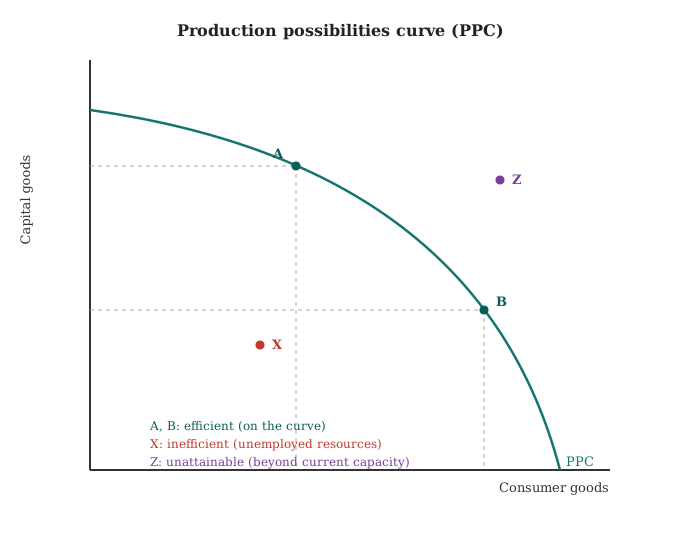
The PPC and key concepts
- Scarcity: We cannot produce outside the PPC — resources are limited.
- Choice: Because of limited resources, we must choose which combination of the two goods to produce.
- Opportunity cost: Moving from one point to another along the PPC means producing more of one good by giving up some of the other — that is the opportunity cost.
Shapes and opportunity cost
Various factors of production are better suited to producing one good than the other. Producing more and more of one good requires using factors less and less suited to it, so opportunity cost rises as you move along the curve.
Factors of production are equally suited to producing either good, so they can be switched between uses at a constant cost.
Shifts of the PPC
| Change | Effect on PPC | Why |
|---|---|---|
| Improvement in quantity or quality of FOPs | Outward shift | More or better resources increase productive capacity |
| Improvement in technology | Outward shift | Same resources can produce more |
| Loss of resources (e.g. natural disaster) | Inward shift | Productive capacity falls |
| Technological improvement in one good only | Outward on one axis only | Only production of that good is affected |
| Moving from inside toward the curve | Point moves, curve stays | Actual growth — reducing unemployment of existing resources |
The Circular Flow of Income
Notes on the circular flow of income model, leakages, and injections will be added here.
Practice questions for this topic will be added here.